Gummworld2 - 0.0.12
Gummworld2 is a pygame framework for a scrolling game, where the map is larger than the display. It emphasizes simplicity and performance.

Gummbum
(gummbum)
Version 2.0.0 is released. New HUD, more speed, less junk.
- There is a new and much improved HUD.
- SpatialHash is much faster thanks to a challenge I made to DR0ID. :D
- Demos are tweaked where needed.
- world editor has been retired.
- PGU has been retired.
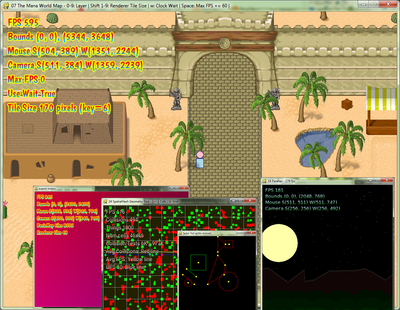
The full image of the screenshot collage is available in Gummworld2 Downloads (gw2_screenshots.png), as well as the individual screenshots used to make the collage.
Enjoy!
::: About :::
Gummworld2 is a pygame framework for a scrolling game, where the map is larger than the display. It emphasizes simplicity and performance. You add the display elements and game logic, the engine provides the framework for timing, events, updates, and rendering.
Tiled helpers are included for elaborate mapping. However, Tiled is not required.
Source and documentation, plenty of uncomplicated examples, as well as some elaborate ones are included. Source available at Bitbucket. The wiki cites completed games.
Compatible with Python 2.7 and 3.x.
The fast renderer BasicMapRenderer matured in v0.5.0. The Mana World's map01 blazes. It is a five layer map with many SRCALPHA tiles. See examples/07_tiled_tmw_renderer_complete.py. This is super fast. The demo examples/29_basic_map_renderer.py renders 8,000+ tiny tiles at 800 fps, and typically sluggish jobs like dynamic hex maps at very high speeds.
::: More :::
Also available in downloads (Gummworld2 required):
- gw2_skeleton, a la skellington. Get this for fast skeleton setup. Highly recommended. I've gotten a fair number of how-to questions that are solved by this module layout. (Note: this is not the same as game_skel, also available in downloads. game_skel is standalone, whereas gw2_skeleton is a drop-in skeleton specifically for Gummworld2.)
- The Mana World resources needed by some Gummworld2 examples (sorry, TMW is kept separate because it is GPL v2). This is just a drop-in data directory.
- A fixed-step game clock, a good general-use clock and scheduler.
- Mutable world demos (aka Gummcraft) v1.1 and v1.2.
- The original "bunny roundup game" demo.
- Pyweek 17 entry Harvest Moon.
- Odds and ends: HUD Light, Xbox 360 Controller, ImageCache, SqlNub.
Changes
- Critical fixes to the editor and library.
- Many enhancements to the editor: scaling; cut, copy, paste; niceties for QuadTree support.
- The first demo combining a Tiled map (graphics) and Gummworld2 map (physical).
- pytmxloader groks Tiled tilesets now (thanks, DR0ID!)
- New toolkit function load_entities() for using Gummworld2 editor files in games.
The full change log is here.
Links
Releases
Gummworld2 0.3.0 — 28 Nov, 2011
Gummworld2 0.4.4 — 23 Aug, 2013
Gummworld2 1.0.0 — 25 Mar, 2015
Gummworld2 0.0.0 — 31 Dec, 2010
Gummworld2 0.0.2 — 3 Jan, 2011
Gummworld2 0.4.0 — 6 Apr, 2012
Gummworld2 0.0.4 — 7 Jan, 2011
Gummworld2 0.0.5 — 10 Jan, 2011
Gummworld2 0.0.11 — 8 Feb, 2011
Gummworld2 0.1.0 — 27 Feb, 2011
Gummworld2 0.0.10 — 29 Jan, 2011
Gummworld2 0.0.9 — 22 Jan, 2011
Gummworld2 0.1.1 — 25 Mar, 2011
Gummworld2 0.0.12 — 20 Feb, 2011
Gummworld2 0.2.0 — 21 May, 2011
Gummworld2 0.4.1 — 28 Mar, 2013
Gummworld2 0.4.3 — 20 Aug, 2013
Gummworld2 0.5.0 — 16 Apr, 2014
Gummworld2 0.4.2 — 6 Aug, 2013
Gummworld2 0.4.5 — 26 Mar, 2014
Gummworld2 2.0.0 — 15 Sep, 2017
Pygame.org account Comments
Recent Releases
 SUPER JUMP DUDE - 0.6.3
1 Jun, 2026
SUPER JUMP DUDE - 0.6.3
1 Jun, 2026
 Imperial Ambitions - Three Kingdoms - 1.0
19 Mar, 2026
Imperial Ambitions - Three Kingdoms - 1.0
19 Mar, 2026
 Pygame menu - 4.5.4
19 Feb, 2026
Pygame menu - 4.5.4
19 Feb, 2026
 pgRPG - ECS pygame Game Engine - 0.1.0
4 Feb, 2026
pgRPG - ECS pygame Game Engine - 0.1.0
4 Feb, 2026
 AS Arrow - v 0.1.4
28 Jan, 2026
AS Arrow - v 0.1.4
28 Jan, 2026
 koxinga - v0.3.3
27 Jan, 2026
koxinga - v0.3.3
27 Jan, 2026
 PyDPainter - Release 2.2.1
21 Jan, 2026
PyDPainter - Release 2.2.1
21 Jan, 2026
 Trosnoth - 1.23.0
18 Jan, 2026
Trosnoth - 1.23.0
18 Jan, 2026
 Royal Ordains - 0.2.4
5 Jan, 2026
Royal Ordains - 0.2.4
5 Jan, 2026
 Divide & Conquer - 1.0
ALL the tags!